Thursday, June 16, 2011

Rory McIlory fires 65, leads U.S. Open by 3

 Rory McIlroy didn't take long to show that his Masters meltdown two months ago didn't leave any major scars.

Four birdies in the first 10 holes – starting on Congressional Country Club's tougher nine – carried the 22-year-old pro to another strong first-round run in a major. By the end, a 6-under-par 65 was good for a three-stroke lead over his nearest pursuit.

"I felt very comfortable," McIlroy said. "It doesn't feel like a typical U.S. Open, for some reason. The golf course is going to get harder and going to get trickier, but I think it's quite fair."

McIlroy opened last year's British Open with a 63, matching the record for a major championship, and led the Masters after a first-round 65. A couple of major champions head the chase pack – current Masters titleholder Charl Schwartzel and former PGA Championship winner Y.E. Yang, both with 68s.

"It's always easier to be in front than to be chasing," said Yang, who famously became the first man to chase down Tiger Woods in a major when he did it two years ago at Hazeltine.

British Open titleholder Louis Oosthuizen was another shot back, overcoming a bogey/bogey start to head an international six-pack of players who posted 69s. He was joined by Spain's Sergio Garcia, Brazil's Alex Rocha, Australia's Scott Hend, South Korea's K.T. Kim and American Ryan Palmer.

Early-day drizzle gave way to mostly cloudy skies at Congressional, encouraging players to take aim at more birdies. Even so, the average score through the first wave of players was 73.9.

"No one's going crazy," said defending champion Graeme McDowell, five shots back after an opening 70. "The pins were really generous in places and no one's really going deep."

Well, except McIlroy. The Northern Ireland lad hardly sniffed the threat of bogey all day, missing just one green – and saving par from a bunker at No.14.

It was a far cry from his most recent nine in a major – started when a wild drive at Augusta National's No.10 sent him crashing out of the Masters lead with a triple bogey. A bogey and double bogey followed – giving back six shots to par in three holes.

"You just move on; that's all you can do," the Ulsterman said earlier in the week. "It's not the end of the world. You analyze it, you pick things from it what you think you could have done better. And when you get yourself into that position again, you try and put those things that you want to do better into practice."

It promised to be a far better day than any of the top three players in the world rankings. Playing in the same threesome, No.1 Luke Donald, No.2 Lee Westwood and No.3 Martin Kaymer combined to shoot 10-over par.

"It just didn't work out," said Westwood, whose 4-over 75 was the worst of the bunch. "We'll shoot better scores tomorrow, hopefully."

Donald and Kaymer each carded 75s.

"We're just hoping for a better score tomorrow," Kaymer said. "Luke's always a very consistent player - fairways, greens. But he was struggling a little bit, Lee was struggling. We couldn't get anything going."

Westwood said: "It's just not a very good score - and [birdies were] there for the taking. ... I thought the golf course was in great shape. I thought somebody could go out and shoot 66."

Tiger Woods is sitting out this week, remaining home in Orlando to let an ailing left knee and Achilles tendon heal. He has played just nine competitive holes since the Masters, withdrawing midway through his opening round at The Players Championship.

It's also the first major Woods has missed since the 2008 British Open and PGA after he underwent reconstructive surgery on the left knee. He hadn't missed a USGA championship since his 1991 debut at the U.S. Junior Amateur.

Wednesday, June 15, 2011

NFL, NFLPA negotiators making some progress


Negotiations completed for the day and likely the week, NFL owners are setting sights on their upcoming meeting in Chicago. Many players are looking beyond then — with optimism — toward getting back to work.
NFL Commissioner Roger Goodell and several owners completed two days of talks Wednesday with NFL Players Association chief DeMaurice Smith and a group of players in Maryland. A person with knowledge of the negotiations told The Associated Press that the two sides have been making progress at several such meetings in the last three weeks.
The person, who spoke anonymously because details cheap jerseys of the discussions aren't supposed to be made public, also said a new collective bargaining agreement is not imminent.
Nonetheless, several players expressed confidence that a deal will get done soon and training camps will open on time late in July.
“I know that we've been talking pretty extensively over the last few weeks,” said New Orleans Saints quarterback Drew Brees, one of 10 players whose names are on an antitrust lawsuit against the league. “It seems like things are moving in the right direction, which is very positive. It's what we always hoped for as players because obviously we're getting to crunch time here.”
Close enough to it.
Although no deadlines have been set for the opening of camps, the 32 teams soon must decide whether to delay them, particularly those clubs that stage a portion of camp out of town. Settling early in July almost certainly would provide for full training camps at previously planned locations, although the Minnesota Vikings have said they could delay until July 18 an announcement on whether they will train at their usual site in Mankato.
“I think everyone kind of has that feeling, that this thing's starting to end,” said Bengals tackle Andrew Whitworth, the team's player representative. “I feel like that's the attitude that everybody has, and you can see everybody preparing that way.
“When you look at the timeline for both sides, it starts to get real serious around this time.”
The lockout is in its fourth month. During that time, there have been mediation sessions, court actions in Minnesota and Missouri, and clandestine meetings between Goodell and Smith, a handful of owners and players. Some of those talks have included lawyers on both sides, some haven't.
Such sessions have been critical in past NFL negotiations, dating to the 1980s.
Brees said to be wary of reports that specific portions of a framework for a new CBA are completed.
“Little steps is good. ... I think the gap is being narrowed in a lot of different areas,” he said. “It's hard to give any kind of prediction at this point, so any percentages that are thrown out there by unknown sources is something that, you can't necessarily believe everything you hear. But there is progress and that's a good thing.”
Movement toward an agreement is in both sides' best interest after a federal appeals court judge warned the owners and players they might not like the upcoming decisions in legal actions sparked by the lockout. Indeed, the court could delay any rulings if a new CBA appears to be near.
If a deal were struck, a free agency period would follow soon after, along with the signing of undrafted rookies. Teams would hold minicamps, which have been put off by the lockout that began March 12.
The labour impasse also has cost the league and some teams advertising and sponsorship money, and some players have not collected workout bonuses. At least seven teams have instituted pay cuts or furloughs of employees who are not players.
The economic pain may not be over. The dealmaking could all come crashing down if one side decides compromise is not in its interest.
“Much can still go wrong — every negotiating session is unique to itself,” said Don Yee, who represents Tom Brady and is an adjunct law professor at USC. “Just because one day was good doesn't mean the next day will be, too.”
That the lockout has lasted this long is frustrating to at least one player.
“In all honesty, being a professional now in an industry that's as big as the NFL is, it's kind of embarrassing that we're even in a lockout,” said Bengals running back Cedric Benson, who will be a free agent once a new CBA is in place. “And having to go through these things and having to come to (the University of Cincinnati) campus and work out and not having a trainer. It's slightly embarrassing, but it is what it is and I have no control over those type of things.
“But it is comforting to hear those guys coming up with a solution.”

Tuesday, June 14, 2011

Game 6 sets CBC hockey ratings record

The CBC says Monday's Game 6 of the Stanley Cup final between Vancouver and Boston was the network's highest-ever rated NHL game.

The game, which saw the Bruins defeat the Canucks 5-2 to tie the series 3-3, averaged an audience of 6.6 million viewers, making it the most-watched NHL broadcast in CBC history, the network said.

The introduction of a new measuring system in September 2009 has seen sports TV ratings skyrocket in Canada.

The game peaked at 8.1 million viewers near the end of the first period and reached a total of 16.2 million viewers — the most ever for the final on CBC.

This is the first Stanley Cup final featuring a Canadian team since the Ottawa Senators played the Anaheim Ducks in 2007.

Game 7 of the series goes Wednesday night in Vancouver.

Monday, June 13, 2011

Long on talent, short on execution

Talent gets you only so far. The rest is up to execution.

This much was painfully clear for the Miami Heat in Game 6. The game of basketball is played on 94 feet of hardwood. It is not played on a preseason stage full of pyrotechnics. It is not played in a cloud of hype.

Put away the MVP trophies. Toss out the All-Star appearances. Forget the ring count.

Ultimately, to win the elusive championship, a team must simply play better basketball over the course of a seven-game series, and the Heat failed in that endeavor.

Why did the Heat lose to the Mavericks in the Finals?

The truth is in the details. With a top-heavy roster, the Heat were long on talent, but short on execution.

“They played great, we came up short, and that's really it,” Chris Bosh said after the game.

They came up short. Heat coach Erik Spoelstra used that phrase four times during his postgame presser, with each echo underlining the sobering fact that his team failed to reach its goal of winning the title. Spoelstra stressed all season that the Heat needed to execute their game plan and stay focused on the task at hand, or else they’d fall short.

And on Sunday, they didn’t just fall short. They looked completely lost in the confines of their home arena. It genuinely appeared as if Sunday was the first time the Heat had played together on a basketball court. They dribbled the ball off their own feet, passed it to the ankles of their teammates, and jumped in the air without a purpose. There was no precision, decisiveness or polish.

All the work they put in since training camp at the military base, all the chemistry that Dwyane Wade, LeBron James and Bosh seemed to build during the regular season, all the poise we witnessed down the stretch against Chicago and Boston -- all of that disappeared before the millions who watched Game 6. We expected their bubbling talent to rise to the top. Instead, it vanished into thin air.

“The habits that we built all season long would suggest that how we played at times during this series was very uncharacteristic,” Spoelstra said. “That's not how we played during the season, and that certainly wasn't the way we played in the first three rounds.”

Spoelstra then diplomatically tipped his cap to the Mavericks.

“A large part of this [struggle] would probably be the competition,” Spoelstra said. “Yes, we will beat ourselves up about so many things we could have done better. But ultimately, that's what this stage is about. And sometimes as tough as it is to admit, sometimes you get beat by a team that it was their time.”

Of all the statistics printed on the page of the box score, none of them carried more weight than the 17 turnovers tallied by the Heat. The miscues alone dragged on the Heat’s offense, but the crushing blow was the fact that the 17 turnovers -- including six by James and five by Wade -- led to 27 Mavericks points.

Let’s start with James. We’re not psychologists so it’s not worth trying to speculate what’s going on between his ears. We can only talk about what we saw -- and boy, was it a train wreck.

One of the most head-shaking moments of the game came with 40 seconds remaining in the first quarter and the Heat down by five. Jason Terry had just missed a 3-pointer. Mike Miller handed the ball to James after pulling down the rebound. James took possession and started dribbling up the court. As James made his first couple trots down the floor, DeShawn Stevenson stepped up to defend James in the backcourt and to put some light pressure on him. But as soon as Stevenson got in his crouch in front of James, the two-time MVP panicked, immediately picked up his dribble and passed the ball to Miller.

The only problem? Miller wasn’t looking. He had already put his head down and started jogging down the court, but James decided to pass to Miller anyway. The ball subsequently bounced off Miller’s heels behind him. Miller had no idea that James had passed it to him until the ball ricocheted off his shoes. Stevenson picked up the loose ball behind the Mavericks 3-point line and drained a 3-spot on the Heat as James helplessly looked on underneath the Mavericks' basket.

It was just one of James’ mind-boggling errors in Game 6, but it illustrated how even the slightest sign of pressure swallowed him whole. James may be 6-foot-8 but he remains one of the best ball handlers in the game, but that moment spoke volumes about how James appeared like a different player on this Finals stage.

James barely penetrated into the paint, but when he did manage to pierce the Dallas defense, he inexplicably passed out at the first touch of resistance in the lane. That led to turnovers too. This was not the same James we were accustomed to seeing muscle his way through multiple defenders and propel himself to the rim like a wrecking ball.

No, James actively avoided contact. Instead of taking it to the rack, he dished it to Juwan Howard -- Juwan Howard! – on multiple occasions in the lane in the second half. James took four free throws during the entire game, and he was lucky to rack up that many considering how timid he looked with the ball.

Of course, Wade wasn’t much better. The Heat can survive if one of the members of the dynamic duo has an off game, but not both. Wade had five turnovers of his own, two coming in the opening minutes of the fourth quarter. Down seven points with just under 10 minutes left, Wade let Terry strip him 40 feet away from the basket. Turnover, going the other way.

A couple possessions later, Wade lost focus and straight-up dribbled the ball off his foot out of bounds. Wade was supposed to represent the steady hand of a guy who’s been there before, but he was no less shaky than James.

And Bosh? Almost all of those backbreaking offensive rebounds by the Mavericks in the fourth quarter occurred because Bosh failed to either box out his man or get his hand on a live ball. All those Tyson Chandler tip-outs? That was Bosh’s guy. Each one of those offensive rebounds was Bosh’s ball to lose.

Sure, Bosh could have probably used a couple more touches on offense -- he recorded only nine shot attempts from the floor -- but he let Chandler beat him to the ball at the worst possible moments.

The Big Three came up short. The most talented trio in the NBA totaled 57 points in an elimination game at home, 10 points fewer than their average in the postseason.

Playing on their home court, Wade, Bosh and James were upstaged by the Mavericks in nearly every facet on the game. The fluid cohesion that we expected to see from the Big Three on the big stage? Nowhere to be found.

The NBA is not a fantasy league. This will be a lasting message of the Heat’s 2010-11 season. You can’t just assemble a talented trio, add up all the individual stats, and start collecting the rings. Basketball is more complicated and more nuanced than that.

For all the hours of highlight reels that the Heat accumulated over the course of the season, the Big Three will remember other things. James will be haunted by all the times he couldn’t puncture the Mavericks' defense. Wade will run through all the shots that he missed and the balls that he coughed up down the stretch. Bosh won’t forget all the rebounds that Chandler stole from his grasp.

You can have all the talent in the world, but the chemistry and execution matters most.

“It’s like a puzzle,” Wade explained after the game. “And their pieces came together a little bit better than ours at the end.”

After the first trial of the NBA's great experiment, the puzzle is still waiting to be solved. 

Sunday, June 12, 2011

Jeter to become first in pinstripes to 3,000 hits

The 3,000 Hit Club is an elite group of baseball's greats. Musial. Ripken. Cobb. Mays. Not one of the 27, though, joined while wearing a Yankees uniform.

Babe Ruth and Lou Gehrig never did it. Neither did Joe DiMaggio or Mickey Mantle. Same for Bernie Williams and Don Mattingly. There's an All-Star roll call of Yankees who came up short for reasons that include illness, injury, wartime service and, frankly, not being wanted any longer in win-now New York.

No. 2 from Kalamazoo is about to change that.

Sometime in the next week or so, Derek Jeter will hold up his right hand to ask the plate umpire for time, give his bat one more ritualistic twirl and then, perhaps take an iconic inside-out swing and send another liner to right field to become the 28th player - and first in four years - to reach the magic number.

Entering the season needing 74 hits for 3,000, this spring was supposed to be more or less a victory lap for the 36-year-old team captain. Instead, it's maybe been the most trying stretch in a charmed career, that after six hitless at-bats, began with a single off Seattle's Tim Belcher on May 30, 1995.

Jeter goes into this week seven away.

"We've always tried to keep things in a positive perspective - that doesn't mean we're not realistic," said Charles Jeter, Derek's dad. "One of the things I admire in my son is the fact that he's able to not dwell on things and to say, 'I'm not going to talk about it' and move on."

The kid from Michigan's ability to "move on" certainly has helped him unlike many other Yankees who played for the blustery George Steinbrenner in media-saturated New York.

Hall of Famers Dave Winfield, Rickey Henderson and Wade Boggs all played in pinstripes before they reached 3,000. In fact, only one Yankees player has gotten a hit after getting there - Paul Waner's last hit, No. 3,152, came during a seven at-bat stint with them in the mid-1940s.

Winfield was one of those players run out of town despite going to eight straight All-Star games in nearly a decade in the Bronx. He is all too familiar with the pitfalls of playing in New York and thinks it's the toughest place to play, which could help explain why no Yankee has reached the milestone.

"I would say it is, just because you have to really focus on playing ball each day more than anywhere else. So if you struggle along the way it could be difficult," said Winfield, an ESPN Baseball Tonight analyst. "They even gave Derek some grief early in the season."

Jeter has managed to stay above the fray for most of his 16-plus consistently stellar seasons - when Steinbrenner criticized him for partying, the owner and young star turned the spat into a lighthearted TV commercial.

Jeter did face the dark side of the organization this winter. General manager Brian Cashman challenged him to find a better offer during contentious contract negotiations that ended in a new three-year deal with a player's option.

Those surprisingly public talks were only the beginning. After hitting a career-low .270 last year, Jeter fiddled with his swing. As he slumped to a .219 average on April 20, he faced relentless scrutiny.

Just when the 11-time All-Star shortstop started looking more confident at the plate after abandoning an attempt at a no-stride swing, Jeter got caught in the middle of Jorge Posada's meltdown. The catcher-turned-designated hitter was dropped to No. 9 in the batting order and once again, Jeter was in the place he tries to avoid nearly as much as losing: the middle of turmoil.

"For a while we weren't even talking about baseball around here, so you can't enjoy anything when you're not talking about baseball," Jeter said.

Still through it all, there was Jeter joking at the cage during batting practice or chatting up a young fan while in the on-deck circle.

"I'm pretty sure he just thinks about going out there and winning a ballgame and everything takes care of itself," said Posada, a longtime friend and teammate. "He keeps everything away, the negativity he puts it behind. He's very good at what he does and he's been doing it for a long time so that helps."

Sure, his .259 average doesn't approach his career .312 mark, but Jeter has reached base in 22 of the 25 games since standing up for Posada. In Oakland, he passed Henderson's franchise record for most steals with his 327th.

Sports talk hosts, columnists and scouts may clamor that two weeks shy of his 37th birthday, Jeter is washed up as a star, but his No. 2 jersey is the No. 1 seller with fans. He's only 1 1/2 seasons removed from a fifth World Series title, winning the Roberto Clemente Award and being chosen as Sports Illustrated's Sportsman of the Year - first Yankees player to earn that honor, too.

"I think the way he's gone about his business, with consistency and just as a professional, being just stubborn enough to be great. He's been a joy to watch," Hall of Famer Reggie Jackson said. "He's everybody's favorite player."

Confident, respectful and as graceful as one of his jump throws from the hole, Jeter won four World Series championships in his first five years. He's noted for playing with a team-first, win-at-all-cost attitude - remember the catch and bloody dive into the stands against Boston.

"He respects the game, he does everything the right way," Red Sox manager Terry Francona said. "I'm a huge fan of his except for when he's hitting."

Major League Baseball plans to have a representative in attendance when Jeter reaches the mark, and at least a dozen licenses for gear commemorating the event will be issued. Jeter's Turn 2 Foundation is marking the occasion with DJ3K bracelets, and the Hall of Fame has talked to him about acquiring game-used mementoes from the day.

"Three thousand hits is pretty good," Yankees great Yogi Berra said in an e-mail. "But I think Jeter cares more about winning than the other stuff."

Always preferring to deflect attention away from himself and onto his teammates, Jeter has been reluctant to talk about the pursuit. He has said he does feel pressure to reach the mark at home, as he did in 2009 when he passed Gehrig for most career hits as a Yankee.

"I'd be lying to you if I told you I haven't been thinking about it," Jeter said after moving within seven hits Sunday. "It's impossible for that not to be in your head, because I'm around that all the time."

Winfield said the Minnesota Twins held him out of the lineup on the road several times, something he understood but wasn't happy about, in order for the University of Minnesota star to notch the historic hit in front of his hometown fans.

Yankees manager Joe Girardi is doing everything he can to keep Jeter in the lineup before he club begins a road trip to Chicago and Cincinnati on June 17.

Returning home from a West Coast trip needing 14 hits in 10 games, Jeter has gone 7 for 28 (.250) in the first six.

Craig Biggio, the last to reach 3,000 in June 2007, understands how those last few can be the hardest.

"I was just grinding and working and not thinking about the number and just going out there playing and trying to win baseball games," the former Houston star said. "Then you get your hits along the way, scratch some off and finally get there. It's an exciting time."

When he does add Mr. 3,000 to the list of nicknames he's earned - Captain Clutch, Mr. November - Jeter will be in some good company, at least until his next hit. He will tie Roberto Clemente, whose namesake award he won for excellence on the field and service off it in 2009.

"That's quite a welcome to the club," Charles Jeter said. "Not only in terms of baseball accomplishments but for his legacy."

Once thought to have a chance at becoming just the third player with 4,000 hits, a more realistic number may be 3,500 - only five have done that.

"That's ways off," Winfield said. "There's a lot that can happen."

AP Sports Writers Tim Booth in Seattle, Josh Dubow in Oakland, Calif., Mike Fitzpatrick in New York and Kristie Rieken in Houston contributed to this report.

Friday, June 10, 2011

Yankees RHP Chamberlain to Have Tommy John Surgery

Yankees reliever Joba Chamberlain is scheduled to have season-ending Tommy John surgery on his pitching elbow next week.

Chamberlain has a torn ligament in his right elbow and is expected to be sidelined for at least a year. Noted orthopedist Dr. James Andrews will perform the procedure Thursday in Pensacola, Fla.

"It's easy to deal with. I know I'm going to get better, and it's not life or death," Chamberlain said. "I'm just happy cheap jerseys that I can fix it and come back and be stronger for it and hopefully have a long career."

In other injury news affecting the Yankees, catcher Russell Martin was out of the lineup for the third straight game Friday night against Cleveland because of a stiff back. Francisco Cervelli was behind the plate, and Martin said there's a "good chance" he'll be ready to play Sunday.

"That's what we're hoping," he said.

Martin had an MRI on Thursday and the results were negative. He said his back was feeling better and he plans to hit and throw Saturday.

"Still a little bit of discomfort, but compared to the first couple days, it's night and day," Martin said.

With his No. 1 catcher out, Yankees manager Joe Girardi said designated hitter Jorge Posada could move behind the plate in a pinch. Posada spent the past 14 years catching for New York, but lost that job after last season.

"If we're using him, as I said, it'll be an emergency situation," Girardi said. "My hope is he hasn't forgotten."

A test Thursday morning revealed Chamberlain's ligament tear. That came one day after the Yankees put the right-hander on the disabled list with a stiff elbow, the latest setback for their injury-depleted bullpen.

Looking for help, New York selected the contract of right-hander Kevin Whelan from Triple-A Scranton/Wilkes-Barre before Friday's game and optioned outfielder Chris Dickerson to its top farm club.

To make room for Whelan on the 40-man roster, Chamberlain was transferred from the 15-day disabled list to the 60-day DL.

Chamberlain and the Yankees said they had no idea his injury was so severe when he went for the additional checkup Thursday. The team sent reports to Andrews, discussed the situation with him and surgery was scheduled.

The recovery time for elbow ligament replacement surgery, often referred to as Tommy John surgery in reference to the first patient, is usually listed as 12 to 18 months.

"This is a surgery that a lot of people have, that people understand that you know you can come back from this," Chamberlain said. "Surgery is just one-third of it. The rehab is two-thirds of what's going on. So that is an important part and the most important part. Obviously, the guy doing it I think has done it a few times, so I'm pretty confident that he'll do a good job. But the rest lies on me and making sure that I get back to where I can be and even stronger."

Chamberlain said he has spoken with Yankees pitcher A.J. Burnett and others who have had the operation about the long rehab ahead and what to expect.

"Every case is different," he said. "Everybody's body reacts different and everybody handles it different."

The 25-year-old Chamberlain is 2-0 with a 2.83 ERA in 27 games. The Yankees also are missing setup man Rafael Soriano, out with inflammation in his right elbow, and lefty specialist Pedro Feliciano, who has not pitched this year because of a tear in his shoulder.

Chamberlain's father, Harlan, sat in his wheelchair outside the Yankees dugout during batting practice again Friday. The pitcher said his dad was scheduled to be in town until next week.

Thursday, June 9, 2011

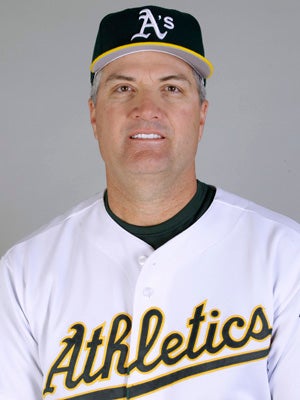
Melvin steps in at right time to save A's

At one point in Moneyball, Michael Lewis quotes an anonymous A's player as saying it wouldn't affect the team at all if then-manager Art Howe was fired.

The manager didn't matter, the player told Lewis. Not with the Billy Beane A's.

Nine years later, the manager does matter. Bob Melvin steps in at the perfect time to prove it.

On Thursday's conference call to announce that Melvin would replace Bob Geren, Beane kept talking about the "challenges" Melvin will face, with four starting pitchers on the disabled list.

"It's the situation Bob inherits," Beane said.

True, but this is also the situation Bob inherits: He takes over a team that was begging for a change. He takes over a clubhouse that Geren had more than lost weeks, months or years ago.

He comes in as the manager who will rescue these players from Bob Geren, which means he couldn't come in at a better time, or in a better place.

"They'll take to him like ducks to water," Phil Garner predicted Thursday afternoon.

Garner should know, because he's been there. Been there with Melvin, who was his bench coach with the Brewers and Tigers, and been there as the guy brought in to rescue a team at midseason.

In 2004, Garner took over a 44-44 Astros team at the All-Star break, when Jimy Williams was fired. Garner's Astros went 48-26 the rest of the way, and came within a win of the World Series. A year later, they went to the World Series.

Garner and Melvin have different personalities, though. Jim Tracy may be a better comparison, but that's fine, too.

Tracy took over the Rockies from Clint Hurdle when they were 18-28 in late May 2009. They went 74-42 the rest of the way, to make the playoffs.

Plenty of other midseason changes haven't worked (including the one the 2009 Diamondbacks made, when they fired Melvin and replaced him with A.J. Hinch). But if there's a team ready to respond to a new voice, this is the one.

And if there's a general manager ready to be convinced that a new manager can make a difference, Beane might be the one.

"Bob's got the rest of this year to make an impact," Beane said, after naming Melvin as the interim manager. "He's got a big job ahead of him. We'll see how it goes. I have a lot of confidence Bob will have a positive impact."

It's not always easy to manage for Beane. It's not going to be easy to turn around a team that has already lost Dallas Braden for the year, and likely won't get Brett Anderson back, either. It's not easy to manage a team that is this offensively challenged, although part of the problem scoring runs may have been that Geren did such a poor job of putting his players in the right spot.

A's players complained about Geren's communication skills, most notably when Brian Fuentes erupted a couple of weeks back in Anaheim.
So it's significant when Garner says that Melvin is a very good communicator.

"Bo does a fabulous job with a pitching staff," Garner said. "And he will communicate."

Melvin has had two previous chances to manage. He replaced Lou Piniella in a difficult situation in Seattle, won 93 games his first year and then lost 99 with an aging club the following year.

He took over for Bob Brenly in 2005 in Arizona, and two years later had the Diamondbacks in the playoffs as the National League West champions. His relationship with his players remained solid even as his relationship with general manager Josh Byrnes deteriorated, eventually leading to Melvin's firing in 2009.

"He's well-respected and very intelligent," Beane said. "He's got a great reputation."

Beane wouldn't say whether he believes Melvin is taking over a team that can or should make a run at the playoffs. He mentioned the injuries when asked if this A's team is good enough to win, saying, "I think we've yet to know that."

I'm not sure they are good enough, but I am fairly certain we were never going to find that out with Bob Geren as the manager.

And I am fairly sure that a manager can make a difference.

Even with the Moneyball A's.

Wednesday, June 8, 2011

Yankees place Chamberlain on DL

The New York Yankees have placed relief pitcher Joba Chamberlain on the 15-day disabled list with a strained flexor muscle in his throwing arm.
Chamberlain, who is 2-0 with a 2.83 ERA in 27 appearances this season, hasn't allowed a run over his last eight appearances.
First baseman Mark Teixeira was in the starting lineup for cheap jerseys Wednesday's game against Boston, one night after he left due to a right knee contusion. Teixeira was hurt after being hit by a pitch from Jon Lester.
Jorge Posada, who replaced Teixeira, was out of the lineup Wednesday. Posada was with his 11-year-old son, who was having surgery. Posada's son suffers from craniosynotosis, which occurs when an infant's sutures fuse too early and it affects the growth of the brain.
The team made several other roster moves Wednesday, including claiming pitcher Jeff Marquez off waivers from the Chicago White Sox. He had pitched in one major league game, last year for Chicago.
The Yankees also transferred third baseman Eric Chavez from the 15-day to the 60-day DL, optioned pitcher Hector Noesi to Triple-A Scranton/Wilkes-Barre, and added pitcher Amauri Sanit to the major league roster. Sanit was on the DL in the minors due to a leg injury.

Tuesday, June 7, 2011

NBC/Comcast wins rights to next four Olympic Games

NBC/Comcast has won the U.S. rights for the next four Olympic Games.

The media conglom paid $4.38 billion to televise the 2014 Winter Games in Sochi, Russia, and the 2016 Summer Games in Rio de Janeiro, as well as the 2018 and 2020 Games, for which the sites have not been selected.

NBC has broadcast the Summer Olympics since 1988 and the Winter Games since 2002.

NBC/Comcast outbid Fox Sports and ESPN — a division of Disney, which also owns ABC. All three companies had submitted sealed envelopes into a see-through plexiglass box, then left the building to let International Olympic Committee officials open them and consider the offers in private. That according to the Associated Press, reporting from Lausanne, Switzerland.

The IOC received “three excellent bids,” but in the end decided to go with its “long-standing partner NBC,” committee President Jacques Rogge said Tuesday. Rogge said that NBC “has a track record for broadcasting the Games that speaks for itself” and that the network had a “clear and innovative” idea for how to grow that coverage.

In its pitch, NBC said that it would offer live coverage of every event on one of the NBC/Comcast platforms and that its broadcast network would continue its tradition of tape-delayed Games play — laced with those (treacly) human-interest stories that viewers lap up.

ESPN offered “best wishes to Comcast/NBC” on securing exclusive U.S. rights to the Games. On the other hand, ESPN also said, as if it meant it to sting, that its own “compelling” offer had “included the enthusiastic participation of all the Walt Disney Company’s considerable assets.”

“We made a disciplined bid that would have brought tremendous value to the Olympics and would have been profitable for our company,” ESPN said Tuesday in its concession statement. “To go any further would not have made good business sense for us.”

Fox Sports Media Group Chairman David Hill also had things he wanted to get off his chest. He congratulated NBC/Comcast but added that Fox Sports’s bid would have provided “the largest marketing platform ever and an economic package we believed to be good for the IOC and [Fox parent company] News Corp.”

The announcement comes less than three weeks after Dick Ebersol — the charismatic NBC suit who has been the face of Olympics coverage in this country for a couple of decades — resigned abruptly when his contract-renewal talks collapsed.

(Ebersol’s the guy to thank/blame for all those human interest stories that litter Olympics coverage.)

NBC previously skunked ESPN and Fox in 2003, when it coughed up more than $2 billion for U.S. rights to the 2010 Winter Games in Vancouver, B.C., and the 2012 Summer Games in London.

On the other hand, NBC lost more than $200 million on the Vancouver Games.

Ebersol was to have been part of the NBC/Comcast entourage in Lausanne, pitching the IOC on the U.S. TV rights to the next round of Olympic Games. Ebersol was replaced by Mark Lazarus, the new chairman of NBC Sports Group, who had this to say Tuesday:

“It is a great thrill to know that NBC’s unsurpassed Olympics heritage and unprecedented partnership with the IOC will continue through 2020.”

Monday, June 6, 2011

Pirates Take UCLA Righty Cole With No. 1 Pick

The Pittsburgh Pirates selected hard-throwing UCLA righty Gerrit Cole with the No. 1 pick in the baseball draft Monday night.

Cole, a 6-foot-4, 220-pound junior, posted mediocre numbers this season for the Bruins (6-8, 3.31 ERA), but has what many consider to be the best pure stuff in the draft. His college teammate, right-hander Trevor Bauer, wasn't far behind, going third overall to Arizona.

Cole was a first-round pick of the New York Yankees in 2008, but refused to listen to an offer and instead attended UCLA — as he insisted to teams he would.

The Pirates, picking No. 1 for the fourth time in franchise history, are hoping Cole ends up being the ace of their pitching cheap jerseys staff. He has a fastball that's consistently clocked at 95 mph and was up around 100 at times late this season. Cole's changeup and slider are also outstanding.

"Gerrit Cole has the size, strength, overall package of stuff and mentality to develop into a top-of-the-rotation major league starting pitcher," said Greg Smith, the Pirates' director of scouting.

Cole is the latest promising young arm that Pittsburgh, which finished with baseball's worst record a year ago, has added in the last two drafts. The Pirates took a pair of high school right-handers with their first two picks last year in Jameson Taillon and Stetson Allie, giving them three potential front-line starters.

With the second choice, the Seattle Mariners tabbed Virginia lefty Danny Hultzen, the Atlantic Coast Conference pitcher of the year the last two seasons. Watching with family and friends, Hultzen looked stunned when the pick was announced, putting his hands on his head.

"This is completely unexpected. It's a huge honor, though," Hultzen said in an interview on MLB Network. "I'm very excited. ... I really don't know what to say right now. I'm completely speechless."

Hultzen, a junior, is 11-3 with a 1.57 ERA and 148 strikeouts while leading the top-ranked Cavaliers to the super regionals of the NCAA tournament.

Arizona, which had two of the first seven picks, couldn't pass up Bauer at No. 3. The Pac-10 pitcher of the year outshined Cole statistically, going 13-2 with a 1.27 ERA and a Division I-leading and Pac-10-record 203 strikeouts. He ended the season having thrown nine straight complete games.

With the seventh pick, the Diamondbacks took another pitcher in right-hander Archie Bradley from Broken Arrow High School in Oklahoma. Bradley went 12-1 and fanned 133 against just 11 walks in 71 1-3 innings while posting a 0.29 ERA this year. He was also considered one of the country's best quarterback prospects and is committed to play football at Oklahoma.

At No. 4, Baltimore selected Bradley's good buddy, Dylan Bundy, another high school pitcher from Oklahoma. The 6-foot-1, 200-pound righty went 11-0 with 158 strikeouts and only five walks in 71 innings for Owasso High School.

It was the first time since the amateur draft began in 1965 that the first four selections were all pitchers.

Kansas City ended the run on the mound by taking a local high school outfielder in Bubba Starling. The Royals have had their eye on the star out of Gardner-Edgerton High School in Kansas since he was 14. And, for good reason.

The 6-5, 200-pound Starling is one of the most impressive all-around athletes in the draft and has eye-popping power. He'll now have a difficult decision: Starling has already committed to Nebraska to play quarterback after rushing for 2,471 yards and 31 touchdowns, and throwing for 790 yards and eight TDs last season.

Anthony Rendon, a slick-fielding and sweet-swinging third baseman from Rice, celebrated his 21st birthday by going sixth overall to Washington. He was hampered by a strained shoulder for most of this season, limiting him to DH — although he played some second base in the postseason. Still, he hit .327 with six homers and 37 RBIs. Teams also constantly pitched around him, as evidenced by his Division I-leading 80 walks.

The last time the Pirates had the top pick in the draft they selected pitcher Bryan Bullington in 2002. They also took pitcher Kris Benson at No. 1 in 1996 and infielder Jeff King in 1986.

"We're working hard to never pick No. 1," Pittsburgh general manager Neal Huntington said.

Washington chose slugger Bryce Harper with the first pick last year.

Friday, June 3, 2011

Heat chilled by Mavericks: A fan’s reaction

Game 2 on June 2, 2011, between the Miami Heat and Dallas Mavericks was some otherworldly type stuff. This game was all but in the bag nearly halfway through the fourth quarter. Many are claiming it was an overconfident LeBron James(notes) and Dwayne Wade that help turn the tides in the Mavericks' favor. I say it was just how basketball goes sometimes, and that is why I love the sport.

OK, first things first: both of my predictions for Game 1 and Game 2 did not pan out, so sue me (not really). What is so cheap jerseys interesting about them is that when I thought the Mavs would win, they lost, and when I thought the Heat would prevail, the freak show of Game 2 occurred. It is like my picks are right in some parallel universe, because little else can explain the way Thursday's night game concluded.

I must say, this is some exciting basketball playing going on around here. In each quarter they were neck and neck and by halftime the score was tied 51-51. It literally was anybody's ballgame. And then the fourth quarter happened.

I saw it for myself: the Heat were up by at least 14 points not even 6 minutes into the final quarter. Believe me, I still knew there was plenty of time left, and nothing was conclusive. I also did not think that the Mavericks would all of a sudden start a run like they did, that basically had even the Heat frozen in their gym shoes like statues.

It was like Dallas could not miss. They made every important and critical shot, and Nowitzki did not look like his injured "pinky" finger was standing in his way to make those layups and that 3-pointer in the closing minutes. Even Kidd sank a 3-pointer, with Terry adding his two baskets, as well. Meanwhile, on the Miami side, there were just crickets.

The Dallas Mavericks pulled off this win by two points, and it went down to the final seconds of regulation. Before I make a prediction on who will take the next one, I want to recalibrate my crystal ball.

But make no mistake, Miami will have an answer for the Mavericks in Game 3.

Wednesday, June 1, 2011

Forecast for Vancouver: Rowdy With a Chance of Chaos

When the Bruins face off against the Canucks in the Stanley Cup finals starting tonight in Vancouver, they might want to steel themselves for a rowdy home crowd.

At least that’s what Howie Rose suggests based on his experience in 1994, when he called games for the Rangers — the Canucks’ finals opponent that year. In a conversation this week, Rose said that the Canucks’ old home, the Pacific Coliseum, was wild, particularly in the sixth game of that series. The Canucks won it to force a seventh and deciding game in New York.

“It was the most raucous building I had ever heard in Canada,” said Rose, now an Islanders’ broadcaster. “The Forum in Montreal was like a library compared to Vancouver in Game 6.”

The Canucks fans were particularly fired up because their team had beaten the Rangers in the fifth game in New York. The local newspapers had been crowing beforehand that cheap jerseys the Cup was the Rangers’ for the taking. When the Rangers lost, 6-3, they had to take the long flight to Vancouver for another potential clinching game.

The Canucks, though, won again, 4-1, to push the series to the limit.

“The Vancouver fans,” Rose said, “were behaving like they just won the Stanley Cup.” On the ride to the airport, the Rangers’ buses passed lines and lines of fans yelling “1940,” a reference to the last year the Rangers had won the Cup. “They smelled blood.”

When the team and its entourage arrived at the airport, the razzing continued. Some luggage tags had “1940” and “Go Canucks” written on them. Immigration officials took extra time checking passports and bags, even though the Rangers had a charter jet.

“At the time, it was sophomoric,” Rose said. “But it added another layer of aggravation to the team.”

The players, Rose said, did not appreciate the humor and it may have motivated them to finish off the Canucks in New York three nights later and end the team’s 54-year championship drought.

The Canucks, by the way, have not won a Stanley Cup since joining the N.H.L. 41 years ago.